.jpg)
What actually separates solid timber from wood veneer? Both are real wood, both are widely used, and both can perform exceptionally well. The key differences emerge in construction, behaviour, and long-term outcomes.
What's the difference?
Solid timber is exactly what it sounds like: a full-thickness plank of real wood, milled and handcrafted to your specifications.
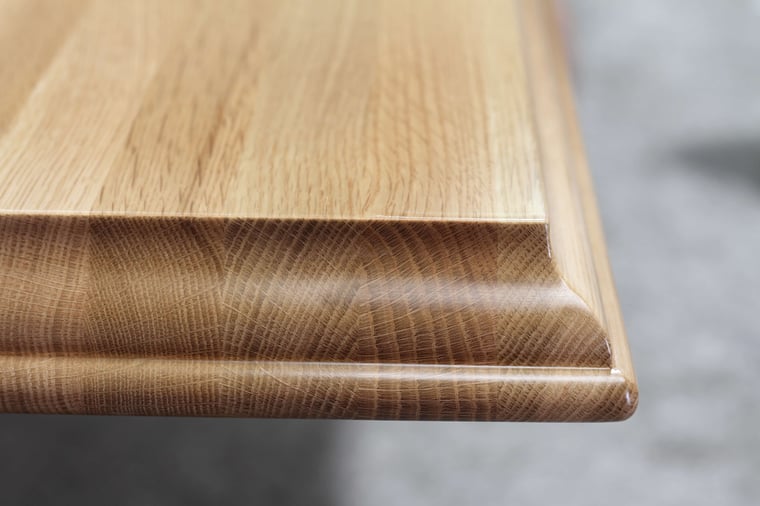
Wood veneers are thin slices of real timber (often as thin as 0.5mm) bonded to a substrate like MDF or plywood. Wooden veneer gives you the look of timber across large, stable surfaces without the weight or cost of going fully solid.%20Print.webp?width=760&height=507&name=Oak%20130mm%2c%20Detail%20by%20Divinia%20Sutton%20(2)%20Print.webp) USA Oak solid 130mm thick - Design by Detail by Davinia Sutton
USA Oak solid 130mm thick - Design by Detail by Davinia Sutton
Aesthetics: character vs consistency
Solid timber has a depth of grain and organic warmth that's genuinely hard to replicate. Every board is completely unique, with natural variations that develop into beautiful patina over time. Boards are always grain-matched to minimise a stripy effect, but some variation is inherent, and for most people, that's the whole appeal.
Wood veneers offer consistent, symmetrical grain patterns across large surfaces. If a project calls for a perfectly uniform finish, veneer is the more predictable option.
One thing worth knowing upfront: if you have your heart set on solid timber but expect every panel to look flawlessly matched with zero variation, veneer will likely be the better fit. The natural individuality of solid wood is one of its greatest qualities, but it can catch people off guard if they're expecting something completely uniform.
Curious about what's available in veneer? Download the Latho Lookbook to browse the full collection of Italian-made, FSC-certified wood veneer panels.

Durability and maintenance
Solid timber is harder, stronger, and fully repairable. It can be sanded back and refinished many times over its life. How much maintenance it needs comes down to the finish. Some options, like a Resin Finish, need very little upkeep, while penetrating oils require more regular attention. Take a look at our finishes page for more information.
Wooden veneer is actually more dimensionally stable: less prone to warping or splitting as humidity and temperature change. That's a genuine advantage in certain environments. The trade-off is repairability. Because the timber layer is so thin, veneer generally can't be sanded after finishing without the risk of sanding through the 0.5mm of timber veneer and exposing the substrate. Damage is harder to address once it happens. However, veneer is comparatively cheaper to replace, so a new look can be achieved relatively easily.
It is worth noting that if both materials share the same finish and are used in the same application, day-to-day cleaning and care requirements are essentially the same. The differences in maintenance come down to finish type, not the material itself.
New Zealand also experiences some of the strongest UV radiation in the world, up to 40% stronger than similar northern-hemisphere latitudes. Any timber product near windows, especially north-facing ones, will change colour over time due to the UV radiation. With timber veneer, the thin timber layer is more susceptible to UV degradation, breaking it down faster and more unevenly than solid timber. The greater thickness of solid timber acts as a buffer, meaning colour change is slower and more even.
Cost
Solid timber is the bigger upfront investment, often running 40 to 50% more than veneer for comparable products. That reflects both the premium material and the craftsmanship involved. Think of it as a long-term investment in something that holds up and can be refinished rather than replaced.
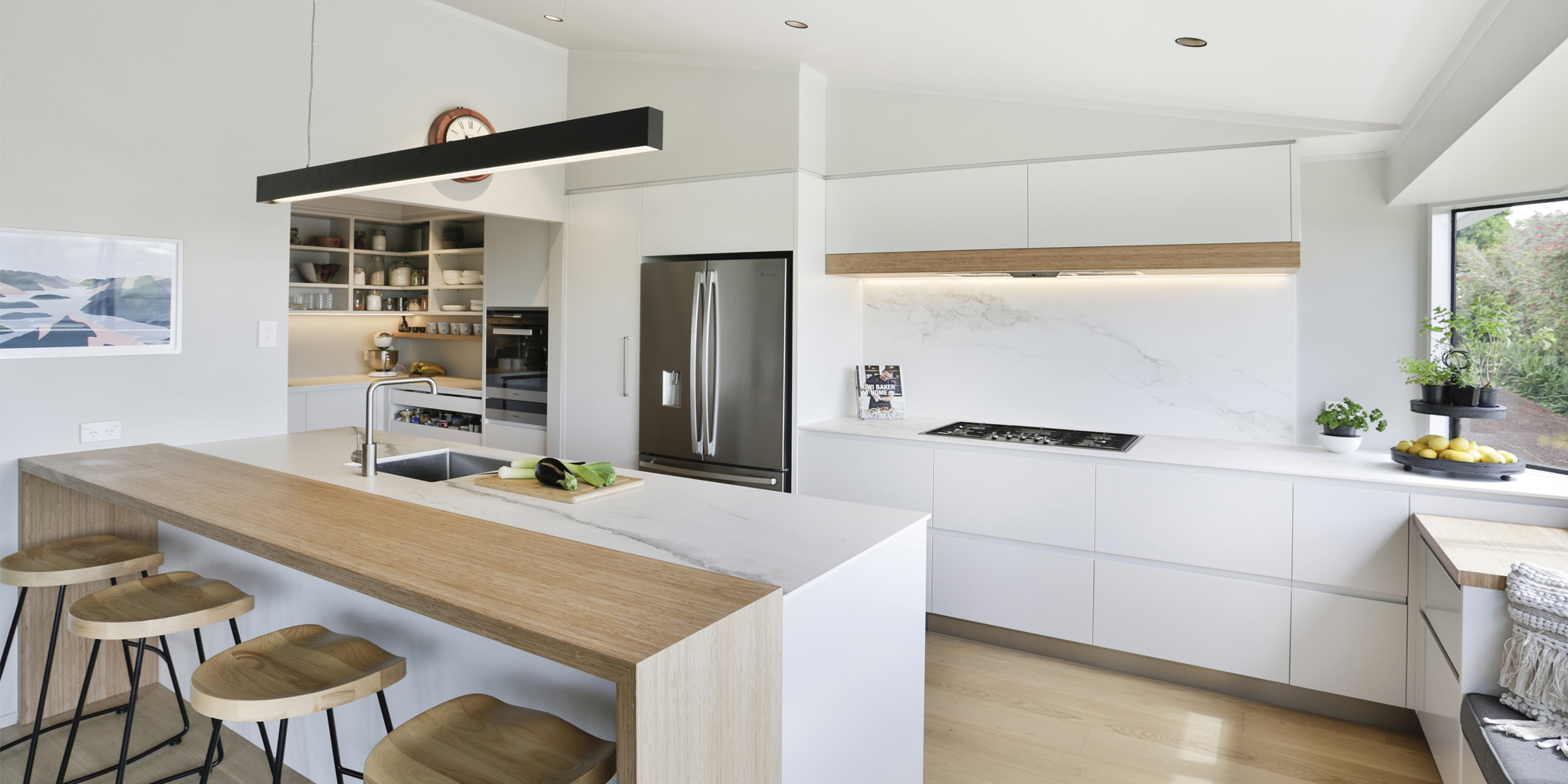
Veneer sheets NZ-wide are a more economical way to bring timber warmth to a space, particularly across larger surface areas where solid wood would become very costly very quickly..jpg?width=4000&height=2667&name=SonnaStudios-1%20(1).jpg) USA Oak Veneer doors - Design by Andrea Ellis of Kitchen Studio North Shore
USA Oak Veneer doors - Design by Andrea Ellis of Kitchen Studio North Shore
Where solid timber wins
For the majority of applications, solid timber is simply the better material. It's stronger, more durable, fully repairable, and the real thing all the way through. Here's where it particularly stands out.
Benchtops (kitchen, laundry, worktops)
Solid timber bench tops handle heavy daily use better than any other material, and can be sanded and repaired many times over decades. Edges can be shaped into deep profiles like bullnose or ogee, and where there's an undermounted sink, solid timber flows continuously to the sink edge in a way veneer can't achieve. The freedom of design and tactile quality it brings are well recognised in high-end and award-winning kitchens.
Solid timber bench tops are also available in lengths beyond 6m with virtually no visible end joints. Veneer sheets NZ-wide max out at around 3m, which limits their use on longer runs.
Shelving
Solid timber shelves carry heavy loads, span longer distances without sagging, and expose clean natural edges with no edge banding required. The load-bearing strength of solid timber far exceeds that of MDF or particleboard cores used in veneer panels, and that difference becomes obvious over time. Veneered shelves with MDF cores are prone to bowing, particularly over spans longer than 800 to 1000mm, whereas solid timber holds its shape for decades.
Screens, slats, and battens
Solid timber can be shaped on all sides: chamfered, curved, and rounded. Because colour and grain run through the entire piece rather than just the surface, any shaping or profiling looks natural and intentional all the way through. Veneer can't be applied to complex shapes or thin slats without risk of peeling or cracking, which rules it out for most screen and batten applications entirely. For high-touch or high-visibility installations where structural rigidity matters, solid timber is the straightforward choice.
Doors
Solid timber doors resist edge damage, can be sanded and refinished, and perform better acoustically. Cabinet doors in particular take a beating over years of daily use, and solid timber handles that wear far better than veneer, which tends to peel or chip rather than repair cleanly.
For doors with deep profiles or routed details, solid timber is the only real option. Exposure to sunlight, humidity changes, or high traffic is also less of a concern: scratches, dents, and UV wear can all be sanded out. A well-maintained solid timber door can last 50 to 100 years, and because it can be restored many times rather than replaced, it generates far less waste over its lifetime.
Where veneer makes more sense
Veneer isn't a cheaper version of solid timber. It's a different material with its own strengths, and in some applications it's actually the better choice:
- Large frameless cabinet panels: Wider, taller surfaces benefit from veneer's dimensional stability, with far less risk of movement or shrinkage over time.
- Bar and island back panels: Stable, economical, and well-suited to the demands of those applications.
- Curved features: Reception counters that flow from bench top into curved front panels, including both internal and external curves, are very difficult to achieve in solid timber. Veneer handles that geometry naturally.
- Flush or oversized doors: For large doors (2.4m and above), veneer on an engineered core resists warping far better than solid timber, keeps weight manageable, and allows grain to be matched across multiple doors in a project. It's also the more stable option in air-conditioned or heated environments where temperature and humidity fluctuate regularly.
For finishing, veneer needs at a minimum a light sealant like polyurethane to protect its surface layer. A Resin Finish is also an option where stronger moisture and wear protection is needed. A more detailed look at veneer costs and applications is covered in this earlier post on veneer feature finishes.
So, which should you choose?
Solid timber remains the stronger long-term choice for most applications: more durable, more repairable, and materially continuous all the way through. That depth gives it an authenticity that veneers, by design, can't fully replicate. For large stable panels, curved features, or projects where budget plays a bigger role, wooden veneer is a smart and practical option.
Not sure which direction suits your project? Download the Woodsmiths Catalogue for a complete overview of the solid timber options available.
%20(1).jpg)